Westwood UCLA Investment Property Essentials
If you are thinking about buying an income property near UCLA, Westwood can look compelling at first glance. You have a major university, a renter-heavy population, and premium rents, but you also have high entry prices, older buildings, and rules that can change the math fast. This guide breaks down the basics so you can evaluate Westwood with clearer expectations and a sharper investment lens. Let’s dive in.
Westwood is not just another Westside neighborhood. It is closely tied to UCLA, which reports 46,678 students and 5,464 faculty members on its facts and figures page. UCLA also describes a campus community of more than 75,000 faculty, staff, and students, which helps explain why rental demand near campus tends to stay durable.
That said, demand is not as simple as assuming every UCLA household is competing for off-campus housing at once. UCLA notes that incoming first-year students are guaranteed up to four years of housing if they want it, and about 11,000 undergraduates live on The Hill, according to the university facts page and the UCLA Parent and Family Guide. For you as an investor, that means off-campus demand is often strongest among upper-division students, graduate and professional students, faculty, staff, and other renters in the area.
The planning framework matters too. The Westwood Community Plan specifically identifies housing for students within one mile of UCLA as a planning objective and points to North Westwood Village, East Westwood Village, and the area south of Wilshire as key nearby rental areas. That makes Westwood a campus-adjacent rental submarket with its own operating patterns.
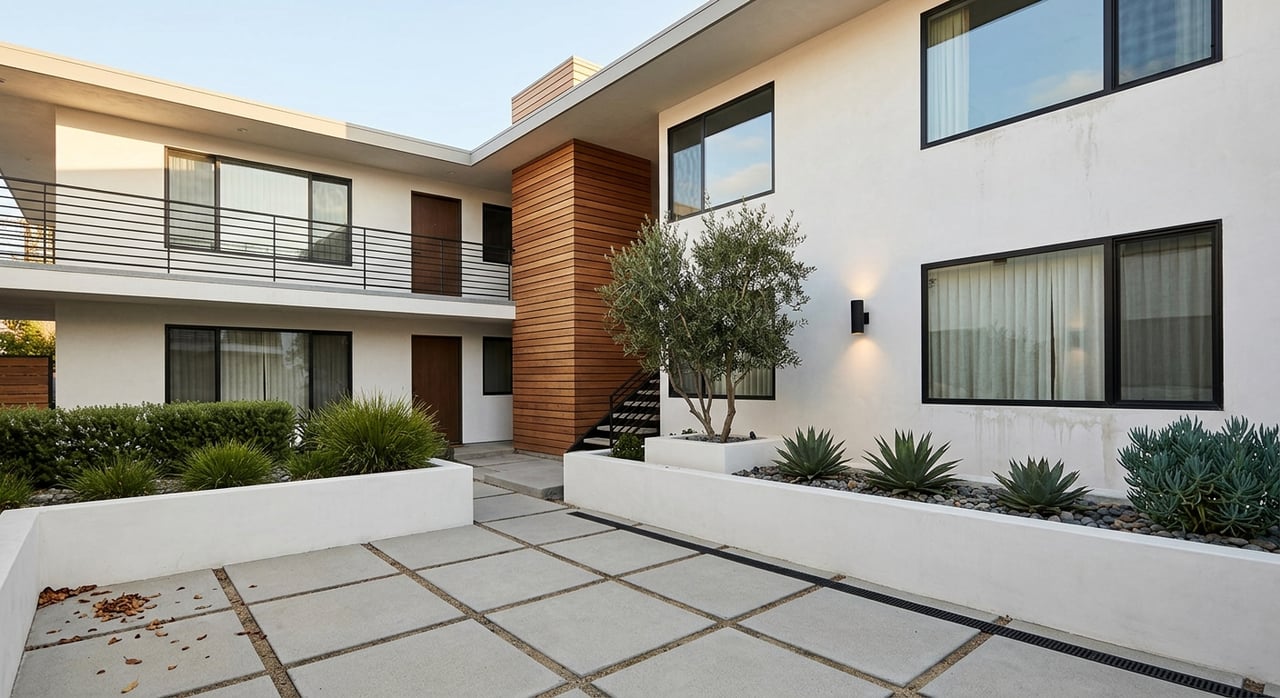
If you are searching for investment property in Westwood, you will mostly be looking at multifamily housing. The current Los Angeles City Planning demographic profile for Westwood shows that 86.2% of housing units are in multiple-housing structures, compared with 13.8% in single-housing units.
The same planning sources note that multifamily housing is concentrated in North Westwood Village, along Beverly Glen and Veteran, and south of Wilshire near Hilgard Avenue. Much of the built environment is made up of low-rise three- and four-story buildings, while higher-rise towers are more concentrated along Wilshire Boulevard. In practical terms, that gives you a market where apartment ownership and condo-style rental formats are much more common than detached-home investing.
Westwood has an unusually student-heavy renter base, but it is not only students. In the same city planning profile, 54.6% of residents were enrolled in school, including 44.3% in undergraduate college and 5.9% in graduate or professional school. At the same time, 66.7% of occupied units were renter-occupied, and 42.5% of households were one-person households.
That combination supports a broad tenant mix. Depending on the property, you may be serving undergraduates in roommate setups, graduate students looking for quieter housing, faculty and staff wanting a close commute, young professionals, and nonstudent renters who value Westwood’s location. For underwriting, that is helpful because it suggests demand is diversified within the renter pool, even though UCLA is the main anchor.
Westwood sits in a premium rent tier by Los Angeles standards. RentCafe’s March 2026 Westwood report shows an average rent of $3,678, with studios at $2,437, one-bedrooms at $3,244, two-bedrooms at $4,384, and three-bedrooms at $7,822.
Another source, Rentometer’s Q1 2025 neighborhood report, places the average lower at $3,207. The exact figures differ because public data sets use different methods, boundaries, and timeframes. The key takeaway is not the exact dollar amount. It is that Westwood rents are high enough to attract investors, but you should treat broad averages as directional rather than as a substitute for property-specific rent comps.
Strong rents are only half the story. On the acquisition side, Zillow’s Westwood housing snapshot puts typical home values at $1,339,711, with a median list price of $1,367,000 and homes going pending in about 62 days as of February 28, 2026.
For you, this creates the classic Westwood tension: high rent, high price. Even when rent levels are strong, the cost to buy can compress your going-in yield. That means a deal that looks attractive on surface rent metrics may still underperform once you account for financing, taxes, insurance, repairs, turnover, and regulatory limits on rent growth.
Vacancy in Westwood can be tricky to interpret. The 2024 city planning profile shows 17.0% vacant units, but that is a broad housing occupancy measure for the community plan area, not the same thing as a brokerage or property management vacancy rate.
For most owners, the more useful lens is seasonality. UCLA’s academic calendar lists fall quarter beginning September 22, 2025, winter quarter beginning January 2, 2026, and spring quarter beginning March 25, 2026, according to the UCLA Parent and Family Guide. That suggests your leasing calendar may revolve more around school timing than around the traditional January-to-December cycle.
If you own in Westwood, leasing strategy often matters as much as rent level. Move-ins, move-outs, roommate changes, and lease renewals can cluster around academic transitions, especially for units that appeal to students.
That can affect everything from marketing timing to make-ready scheduling. If you miss the strongest leasing window, a short vacancy can become much more expensive in a high-cost market. For many owners, planning ahead matters more than trying to chase the last possible rent bump.
In many submarkets, parking is just a nice bonus. Near UCLA, it can be a more meaningful part of the value equation. The UCLA Parent and Family Guide notes that student parking permits are extremely limited and prioritized, while UCLA Transportation offers discounted transit passes and commuter programs.
That means your unit’s appeal may depend heavily on practical logistics. Parking availability, transit access, walkability to campus-adjacent destinations, and smooth move-in conditions can all influence tenant demand. This can be especially important for studios, one-bedrooms, and shared apartments where convenience is a key part of the rental decision.
Westwood’s housing stock skews older. The city planning profile shows that a majority of units were built before 1980, which matters because older buildings may fall under Los Angeles rent regulation rules or require careful legal review.
This is one of the most important parts of underwriting in Westwood. Two buildings with similar rents and similar locations may perform very differently depending on construction date, legal status, in-place tenants, and renovation potential. You do not want to assume flexibility that the property may not actually have.
According to the Los Angeles Housing Department, the city’s Rent Stabilization Ordinance generally applies to rental properties first built on or before October 1, 1978, including apartments, condos, duplexes, and many other residential property types. LAHD also states that the RSO regulates rent increases and evictions.
For many non-RSO units, the state Tenant Protection Act, AB 1482, may still apply. LAHD explains that AB 1482 generally adds just-cause protections after 12 months and caps annual rent increases at 5% plus CPI, up to 10%, for many covered properties. In a market like Westwood, these rules can shape income growth more than neighborhood averages do.
Current city materials show a 3% allowable rent increase for RSO units in the 2025-26 cycle, according to the LA renter protections notification. That is a major underwriting point if you are evaluating older multifamily stock near UCLA.
If a building is rent-stabilized, your value-add plan may need to be more conservative than expected. Instead of assuming fast rent resets, you may need to focus on legal rent review, operating efficiency, unit turn strategy, and the property’s real competitive advantages, such as layout, parking, or location.
For small and mid-sized investors, Westwood is best viewed as a high-rent, high-price, regulation-sensitive market. It may offer durable demand because of UCLA and the broader Westside location, but the best opportunities are usually the ones where the details are tight.
Before you move forward on any listing, it helps to evaluate:
Westwood can absolutely work for investors, but the margin for error is smaller than in cheaper submarkets. You are often buying stability, location, and durable demand rather than easy cash flow.
Because Westwood data can vary by source and boundary, broad market stats are only a starting point. The city planning profile, rent trackers, and housing value reports are useful, but they are not perfect apples-to-apples comparisons. In a neighborhood like this, property-level diligence matters more than headline averages.
That is where experienced local guidance can help. If you want to evaluate a condo, small multifamily building, or other income property near UCLA, working with advisors who understand both Westside market dynamics and investment analysis can save you time and help you avoid expensive assumptions. If you are considering a Westwood acquisition or planning a future disposition, Amy & Augustine Um can help you assess the opportunity with a data-driven, hands-on approach.
Amy & Augustine bring representation with unparalleled strength. They share a personal pledge to treat every person who walks through the door as a top priority, completing each transaction with integrity and professionalism.
Amy Um | CA DRE# 01961595
Estates Director | REALTOR®
(310) 804-5553
[email protected]
Augustine Um | CA DRE# 02146399
Estates Director | CPM© | CAPS© | NPCC | CCRM | REALTOR®
(213) 400-1111
Address
1010 Montana Ave.
Santa Monica, CA 90403